
Insulation R-Value: How well your attic resists heat. R-30 vs. R-38 makes a 15% difference in cooling load.
High-Efficiency AC Installation & Manual J Design
The most important day of your air conditioner’s life is the day it is installed. We don’t guess. We measure. We don’t just hope it works. If we design it, we guarantee it will maintain 75°F in your home on the hottest August day, or we fix it for free.
Get QuoteStop Buying Air Conditioners by “Rule of Thumb”
If a contractor walks into your home, looks at your old unit, and says, “You have a 3-ton unit, let’s put in a new 3-ton,” show them the door.
That is not engineering. That is guessing.
At Service Line Air & Heat, we believe that Installation Quality > Equipment Brand. The most expensive Carrier or Trane system will fail in 5 years if it is sized incorrectly or attached to strangulated ductwork.
We are construction professionals who follow ACCA Manual J Standards to design a system that fits your home’s specific physics.
The “Run Away” Checklist
If your contractor does any of the following, they are guessing, not engineering:
Quotes a price over the phone without seeing the house.
Why it matters: Every home has different window area, insulation depth, and duct configuration. A blind quote means they’re using “average square footage” instead of your actual load.
Says “You have a 3-ton, so you need a 3-ton.”
Why it matters: Your old unit might have been oversized to begin with. Copying the mistake guarantees short-cycling and high humidity.
Does not measure your windows or check insulation depth.
Why it matters: West-facing windows in Mont Belvieu create 20% more heat gain than north-facing windows. If they don’t measure, they’re guessing.
Says “Manual J is a waste of time.”
Why it matters: Translation: “I don’t know how to do it.” Manual J is the industry standard. Skipping it is like a doctor prescribing medicine without checking your weight.
What is a Manual J Load Calculation?
A Manual J is a physics-based calculation that determines the exact heating and cooling load of your home. It does not use square footage alone. It calculates heat gain based on:


The “Bigger is Better” Myth (The Danger of Short-Cycling)
Many homeowners—and lazy contractors—think, “If a 3-ton is good, a 4-ton must be better!”
This is dead wrong.
In the humid climate of Coastal Texas, an oversized unit is a disaster. It cools the air too fast. It satisfies the thermostat in 5 minutes and shuts off.
Technology That Matters: Variable Speed & SEER2
We install modern systems designed for the Baytown climate. Not all equipment is created equal.
Inverter (Variable Speed) Technology
Old ACs are like a light switch—100% On or 100% Off. Variable Speed systems are like a dimmer switch. They can ramp down to 30% capacity on a mild day.
SEER2 Compliance
The Department of Energy upgraded testing standards in 2023. We install SEER2-compliant equipment that meets the rigorous new efficiency benchmarks, ensuring you qualify for available tax credits and rebates.
Translation: SEER2 is harder to achieve than the old SEER rating. A SEER2 16 system today is more efficient than a SEER 16 system from 2022. You’re getting real, tested efficiency—not inflated lab numbers.
The Service Line Installation Protocol
We are builders. We do not cut corners.
The Engineering Assessment
We perform the Manual J calculation and inspect your existing ductwork static pressure. If your ducts are leaking 30% of your conditioned air into the attic, a new compressor won’t fix that.
The Ductwork Upgrade
A new unit cannot breathe through a straw. If your plenum is restrictive, we fabricate a custom one in our Sheet Metal Shop. We don’t force off-the-shelf fittings that leak air.
The Nitrogen Braze
We flow nitrogen through the copper lines while brazing to prevent internal oxidation. Those black flakes you sometimes see in failed compressors? That’s carbon buildup from lazy brazing. We eliminate it.
The Commissioning
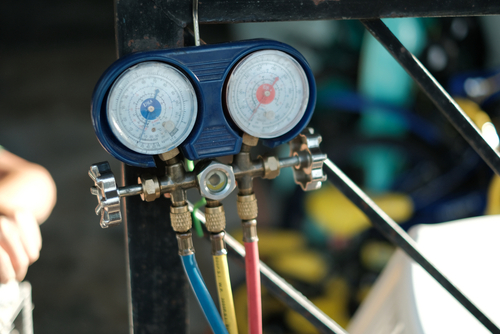
We don’t just turn it on. We balance the airflow across all registers, verify static pressure at the plenum, and adjust the refrigerant charge to manufacturer subcooling targets. Every installation gets a final performance report.
The Micron Evacuation
We pull a deep vacuum (below 500 microns) to ensure the system is perfectly dehydrated. Any moisture left in the lines will freeze at the expansion valve and cause refrigerant starvation. Most contractors stop at 1,000 microns. We go deeper.
Do you want a box dropped in your backyard, or do you want a climate solution?
The difference between a $7,000 installation and a $9,000 installation isn’t the compressor brand. It’s the engineering that goes into sizing, ductwork, and commissioning. That engineering is what makes your system last 15 years instead of 8.